Syllabus
Department of Computer Science · College of Natural Sciences · Colorado State University
- Meets
- Tuesdays & Thursdays, 3:30–4:45 PM
- Room
- Visual Arts, F 113
- Dates
- Classes: August 24 – December 11, 2026 · our meetings: August 25 – December 10 · the term ends Friday, December 18, 2026 (the Friday of Finals Week)
- Final Exam
- Thursday, December 17, 2026, 2:00–4:00 PM
- Instructor
- Francisco R. Ortega, Ph.D. (CSB‑360)
- Co-Instructor
- Zahra Faeze Borhani
- Format
- Graduate seminar + semester-long project, with hands-on agentic AI for research & coding
Status of Syllabus
- This is the Fall 2026 draft. The syllabus is subject to change, provided the class is informed.
Updates to Syllabus
| Date | Description |
|---|---|
| August 21, 2026 | Final draft of the syllabus released |
| September 22, 2026 | Added Zahra Faeze Borhani as co-instructor |
| TBA | Syllabus release |
Professor
Francisco R. Ortega, Ph.D. (NUI Lab).
- Associate Professor (tenured)
- Office: CSB‑360. Available for Zoom/Teams.
- Office Hours: Mondays, 8:00–9:00 AM (online only); Tuesdays, 8:00–9:00 AM (CSB‑360 or online); and other times upon request
- Phone: 1‑970‑491‑7445 (I don't use this number much – use Teams)
- Email: fortega@colostate.edu
Note: Office hours begin the second week of classes and may be cancelled or moved, so please always contact me before coming. I also keep an open-door policy: you are welcome to talk with me at other times, though I prefer that you email me first so I know to expect you. My preferred method of communication for quick questions is Teams. If office hours change, I will announce it via Teams.
Co-Instructor
Zahra Faeze Borhani.
Graduate Teaching Assistant(s)
- Jaya Surya Bontha — jayasurya.Bontha@colostate.edu
- Office: CSB‑225
- Office Hours: Wednesdays, 2:00–4:00 PM (CSB‑225 and online); Mondays, 4:00–6:00 PM (online)
Note: GTA office hours run from the second week of classes through the last week of classes, before Finals Week.
Overview
CS 567 is a graduate course on Human-Centered Computing for 3D spatial interfaces. It brings together 3D user interfaces (AR/VR), spatial AI, and human-centered AI, and teaches you to research and build in this space using agentic AI. A 3DUI is the medium of communication between a user performing three-dimensional interaction and a computer: one where the input, the output, or both are in 3D space.
The course centers on three things.
1. Using agentic AI for XR and HC-AI research and coding
A core skill of this course — and one that is useful well beyond it — is working with agentic AI. We use agentic coding and research agents (Claude Code, OpenAI Codex, opencode, and others, including agentic AI inside VS Code), together with a small multi-agent, multi-machine stack that you will learn to set up and run:
- amux — runs agent sessions in isolated git worktrees per machine, with a web dashboard, so several agents can work in parallel without colliding.
- hcom — a cross-machine, end-to-end-encrypted (XChaCha20) agent-to-agent bus, so agents on different machines can coordinate.
- mosquitto — a private MQTT broker the bus syncs through (network-restricted and password-authenticated).
You will learn to combine local AI models with frontier models and to use this setup for three purposes: coding, system setup, and research. This is Human-Centered AI in practice — you stay the decision-maker and remain fully accountable for what the agents produce, while learning where they help, where they fail, and how to keep a human in control.
A defining feature of CS 567. Hands-on use of agentic AI — the agents, the multi-machine stack above, and local + frontier models — for research and coding is both a learning objective and a core feature of this course.
2. 3D User Interfaces and Spatial AI
The theory and practice of input devices, interaction techniques, and multimodal interaction for 3D user interfaces, and their applications in augmented and virtual reality (AR/VR/XR). Most head-mounted displays will be Meta Quest 3 (with video-see-through AR); some optical-see-through AR (e.g., HoloLens 2) and additional input devices may be available.

Spatial AI is the perception-and-memory side: first-person (“egocentric”) AI on wearable glasses. These come in two forms: non-display glasses with a camera, microphones, and an on-device assistant but no screen (e.g., Ray-Ban or Oakley Meta), and display glasses that put information in the lens (e.g., Meta Ray-Ban Display, Orion). Display glasses also differ in whether the display is monoscopic (a single 2D overlay, like the Ray-Ban Display’s monocular right-lens screen) or stereoscopic with binocular depth (like Orion). We look at how these devices sense and remember the world, how on-glasses assistants answer questions and recall context (egocentric vision-language models with retrieval and memory), and how this connects to spatial intelligence and world models.


Some of these devices break from the classic definition of AR. Azuma (1997) requires three things: it combines real and virtual, it is interactive in real time, and it is registered in 3D. Non-display glasses meet none of these in the visual field, since they assist through audio and AI, and a monoscopic display shows 2D, head-locked content that is not registered in 3D.
Azuma, R. T. (1997). A Survey of Augmented Reality. Presence: Teleoperators and Virtual Environments, 6(4), 355–385.
3. Human-Centered AI
Designing AI that keeps people in control: interpretable, mixed-initiative, human-in-the-loop, and aligned with human needs — including how smaller models can still be useful given compute constraints versus frontier models.
A human-centered question runs through the whole course: how do people make decisions as model capacity changes, from small on-device language models (SLMs) to large frontier LLMs? As capability grows, so do cost, latency, privacy exposure, and the chance of confident-but-wrong answers — so what a person should delegate, verify, or keep under direct control shifts along the spectrum. We treat that as a design question, not a fixed answer.
You can also do non‑VR/AR work. As a graduate course, the emphasis is on reading state-of-the-art and foundational research and on carrying out a substantial project from proposal through implementation and a research paper. Students may use any game engine, language (e.g., Rust), or toolkit they prefer; the class emphasizes interaction and intelligence in 3D space.
NIST Collaboration
This semester, the National Institute of Standards and Technology (NIST) — whose researchers have worked extensively with CAVE systems and AR/VR — will collaborate with our class to propose real research projects. NIST is also recruiting interns in this space.
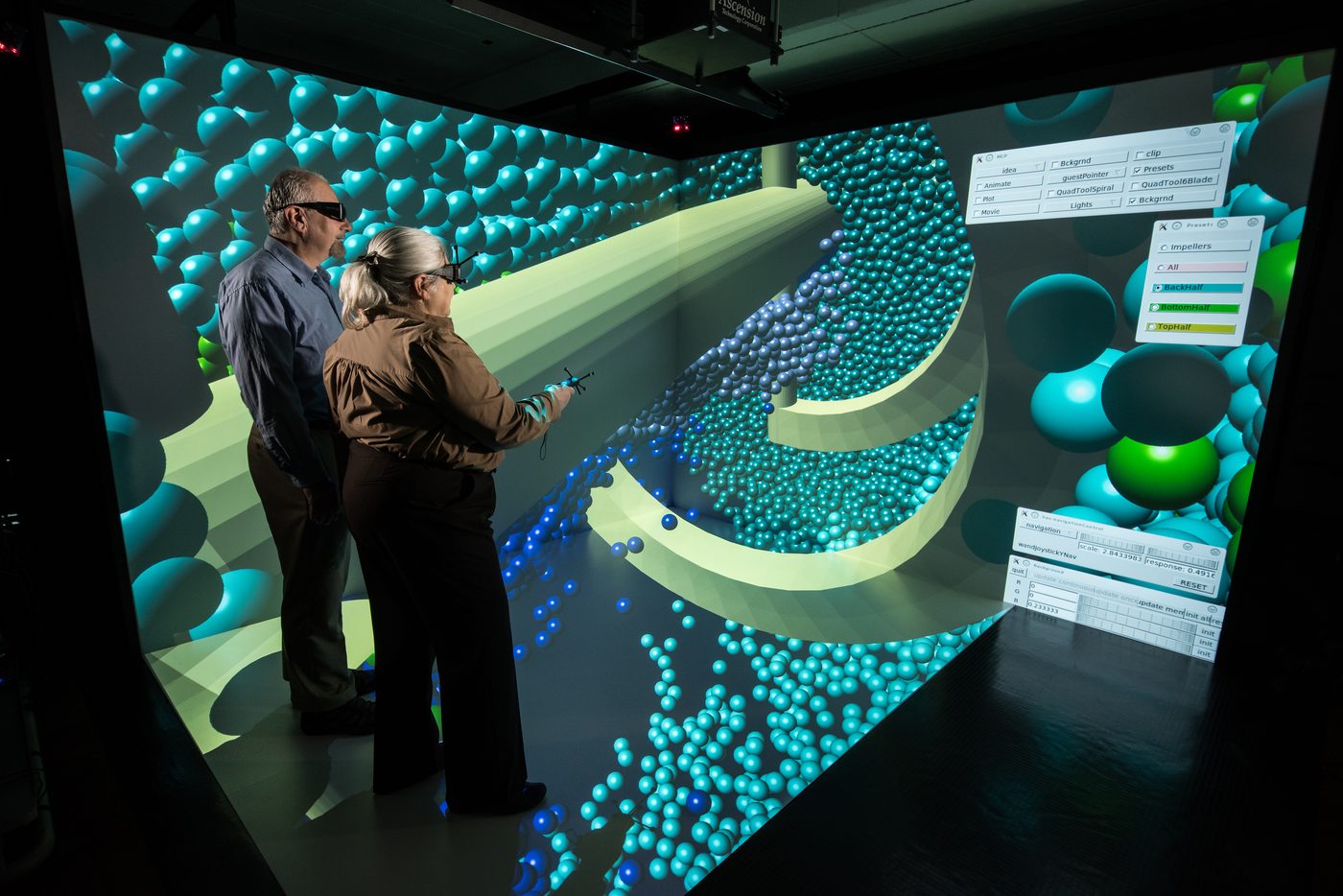
Important: The NIST internship requires U.S. nationality. However, every student in the course — regardless of citizenship — may work on the NIST-proposed projects. The internship is a separate opportunity from the coursework. Project topics, scope, and NIST points of contact will be shared early in the semester and posted on the Project page.
Faculty Collaboration
You are also welcome to work on a problem with your own faculty advisor (or another faculty member), as long as the project is related to this course — that is, it advances 3D user interfaces, Human-Centered Spatial AI, or the use of agentic AI for that research. Talk to me early so we can scope it to the course requirements (proposal, progress, paper, and implementation). Your work and authorship remain your own, and you stay accountable for what you submit.
Course Objectives
By the end of CS 567, you should be able to:
- Understand the theory and concepts behind input devices, interaction techniques, and multimodal interaction for 3D user interfaces.
- Read, evaluate, and synthesize current research across 3D user interfaces and Human-Centered Spatial AI.
- Design and reason about AI-enabled spatial systems that keep humans in control.
- Use agentic AI tools (Claude Code, opencode, and others), a multi-agent / multi-machine stack (amux, hcom, mosquitto), and local + frontier AI models effectively and responsibly for research, coding, and system setup — keeping a human in control and staying accountable for the results.
- Plan and execute a graduate-level research project, including an implementation and a written research paper.
- Communicate research progress clearly through regular presentations and writing.
How This Class Is Using LLMs This Semester
Disclosure matters. As part of his research interest in the intersection of agentic AI with XR and HCI, the instructor has been using a range of models — both local and frontier — to edit text, generate content, and assist with course material, while still making every decision himself. The buck stops with the professor. Agentic AI is a tool, nothing more. We will talk about this at length in class.
Use of AI in CS 567
AI is allowed in this course, but it is optional — you are never required to use it. If you do use it, you remain fully responsible and accountable for everything you submit. AI is a tool, not a substitute for understanding.
- Coding: Use AI to explain concepts, scaffold, and debug. You may not submit work you cannot explain. If I ask you about your code or results and you can't account for them, you may receive a zero. The work is yours; "the AI did it" is not a defense.
- Writing: You may use AI to help you write and edit (including tools like Grammarly). The ideas, claims, and citations remain your responsibility, including verifying that every reference exists and is relevant. Weak or unsound AI-generated text increases the risk of rejection and lowers your grade.
For the paper, we follow the current ACM Policy on Authorship. Two points matter:
- Writing assistance: ACM does not require disclosure, but this class does. ACM no longer requires you to disclose AI used to assist with writing the submission, but the class does — IEEE requires it as of today, other venues may, and you often will not know the venue in advance. Research methods must always be disclosed.
- Research conduct must be disclosed. When AI is used in the research itself — for example data analysis, running statistics, selecting or generating data, implementing models, running simulations, or producing code, datasets, or figures that affect your conclusions — you must describe that use in detail in the methods section.
In short: AI help with writing and editing needs no disclosure for ACM, but this class requires it — IEEE needs it as of today, and you simply may not know the venue. AI used to produce results, applications, and related items does need disclosure. Every named author is fully accountable for the integrity of the work, whatever its source. (If you target a non-ACM venue, check that venue's policy.) Critical thinking is the point: you can only judge AI output if you have the foundational knowledge to evaluate it. However you use it, you are responsible for your submissions.
Email, Canvas, and Teams
Email, Canvas, Teams, and this syllabus (plus the Project page) are critical. Check the syllabus, Teams, and Canvas regularly. Sessions may be recorded, but I can't guarantee the system's functionality.
How to communicate
Be respectful and concise, but provide enough information for me to understand your question. Please follow these guidelines:
- Use Teams for a faster response. Use email for private or essential matters where timing is less critical. When emailing, CC the GTA(s) and begin the subject line with "CS-567". If I don't reply within 48 hours, email again. Use "URGENT" only when truly urgent (not for a 911-type emergency).
- Do not use the Canvas messaging system to contact the TAs or the instructor.
- Unless it is a private, delicate matter, use Microsoft Teams — either a public channel or a private message. Please include the GTA as well, unless it is something only I need to know.
- All official announcements are sent via Microsoft Teams. You will be added in the first week. Use the correct channel, and be respectful to your peers, TAs, and instructor. Hate speech or harassment will not be tolerated.
- Please address me as Professor, Professor Ortega, Dr. Ortega, or Francisco — your preference. My goal is for you to develop professional communication skills.
- My pronouns are He/His/Him. If I get your pronouns or the pronunciation of your name wrong, please correct me — in private or in class. I have an accent and some hearing/speech differences, so feel free to correct me at any time; it is totally fine.
- I don't know everything about HCI, VR, or AI — these are broad, fast-moving fields. I will always come back with an answer when I can find one.
If a student behaves in a manner considered prohibited conduct, I reserve the right to ask that student to leave immediately and to report the behavior to the appropriate department.
Format & Expectations
This is a graduate course built around reading, discussion, and a semester-long project. As a Human-Computer Interaction (HCI) / 3DUI course, it involves more reading and writing than a typical systems course, while still requiring you to build. Expect to read research papers every week and to write throughout the semester. Professional and scholarly maturity is expected at this level.
This year the evaluation is different from prior offerings. There are no midterm exams, and the only quiz is a low-stakes syllabus quiz. Instead, your grade is driven by continuous evidence of progress: project checkpoints and presentations, a proposal, and a final project (paper + implementation), plus a single cumulative final exam. See the Grading Breakdown for the full list.
Project Teams
You may complete the project solo or in a group of 2, and groups of 2 are encouraged. Both the implementation and the research paper are required deliverables either way, but a group of 2 is expected to produce more than a solo project. If a classmate prefers to work solo, respect that and do not try to talk them into joining you. Details, milestones, and the rubric will be posted on the Project page and on Canvas by the end of the second week.
Prerequisites
Graduate standing in Computer Science, or instructor consent. Programming maturity is assumed. See your advisor or the CS website for details.
Grading Scale
| Grade | Range |
|---|---|
| A | [94, 100] |
| A- | [90, 94) |
| B+ | [87, 90) |
| B | [84, 87) |
| B- | [80, 84) |
| C+ | [75, 80) |
| C | [70, 75) |
| D | [60, 70) |
| F | [0, 60) |
A+: Given only to top students who have gone above and beyond (and already have an A). For your GPA, an A+ is the same as an A.
I reserve the right to curve in your favor per deliverable or for the class. This is uncommon, but if it happens I will announce it.
Grading Breakdown
Your grade is built from the components below. Most of the weight is on continuous, demonstrated progress toward a project and paper.
| Component | Weight | Notes |
|---|---|---|
| Presentations | 20% | Three presentations across the semester; the lowest score is dropped (best 2 of 3). |
| Project progress checkpoints | 20% | Eight check-ins across the semester; the best 5 count toward your grade. |
| Proposal | 5% | Project and paper proposal, early in the semester. |
| Final project — publication-ready paper | 20% | Written in LaTeX; may include experiments if applicable. Solo or groups of 2. |
| Final project — implementation deliverable | 18% | Working implementation accompanying the paper. |
| CITI training certificate | 1% | Responsible conduct / human-subjects research training. |
| IRB submission | 3% | Required where the project involves human participants. |
| Syllabus quiz | 1% | Unlimited attempts. |
| Final exam | 12% | Cumulative. Thursday, December 17, 2026, 2:00–4:00 PM. |
| Total | 100% |
There are no midterm exams; the only quiz is the low-stakes syllabus quiz. Rubrics and exact dates are released on Canvas and the Project page.
Final Exam
There is one cumulative final exam, worth 12%.
| Exam | Date / Time |
|---|---|
| Final Exam | Thursday, December 17, 2026, 2:00–4:00 PM |
The final exam date and time are confirmed by the Registrar and cannot be changed. The exam concentrates on theory and concepts from lectures, readings, and discussion. If a proctoring tool is used, any suspicious activity will be reported.
The AI Dilemma
How computer scientists should use AI to aid coding and writing — and these are different — is an open question I take seriously, alongside the ethical considerations (energy, copyright, confidentiality). I will share my current thinking, as of Fall 2026, and we will discuss it in class. If you let AI do everything, you will not learn, and you will not be able to maintain what you "wrote." Use it to support your learning, not to replace it.
Attendance and Absences
You are allowed six absences over the semester, no questions asked. If you need to miss more than six for documented work- or conference-related travel, bring me the evidence and I will take it into account. This applies to students attending face to face.
Late Work and Make-ups
Because the grade is built on continuous progress, deadlines for checkpoints and presentations matter. I have built the course with ways to drop some items, so a single missed deliverable will not sink you. Late work is not accepted unless I make an exception for a serious case. If a particular submission carries a one-day late policy, I will announce it, and it will come with a 10% penalty on your grade for that submission.
Respect for Others
Be respectful of everyone's right to be who they are, including members of the LGBTQ+ community, minorities (race, ethnicity, etc.), and people of differing gender, culture, personality, and political views. This class deals with humans, so opinions will sometimes differ; we will always use evidence and science to work through the issues. Order in class is required.
If a student behaves in a manner considered prohibited conduct, I reserve the right to ask that student to leave immediately and to report the behavior to the appropriate department.
Important Information Regarding Accommodations for Students
Colorado State University's Student Disability Center (SDC) coordinates accommodations. If you have not registered with the SDC, start at New SDC Student: Get Started; the Accommodations Process and the Accommodation Handbook explain how memos are issued and used.
- Students should contact their instructor/TA/coordinator as soon as they receive their memo from SDC to discuss their individual needs. Students should read the SDC section of the syllabus for each course before the discussion with the instructor/TA/coordinator. The conversation with the faculty member/TA/coordinator should address the specific requests listed in the SDC memo, their applicability, and the reasonable arrangements for each course.
- To the extent possible, students are strongly encouraged to register for lab sections that meet on Monday or Tuesday, to allow for rescheduling later in the week if circumstances require. Since labs follow a weekly cycle, it is generally not possible to make up a lab the following week.
- All students are expected to submit all assignments, including laboratory reports or other assignments associated with laboratory courses, as defined in the course syllabus. Time extensions will generally not be granted for assignments or labs that are collected and graded on a weekly (or longer) basis. This is because scheduled due dates are sufficiently long to accommodate students who require extended time to complete assignments, and many labs build on the skills and concepts learned and developed in prior labs. Extension as a reasonable accommodation may be considered, although circumstances may limit its feasibility.
- It is understood that accommodations cannot fundamentally alter the nature of a course.
- Retroactive accommodations are generally not permitted.
Accommodations
- Contact me as soon as you receive your memo from the SDC to discuss your needs. Please read the SDC section of this syllabus before our conversation.
- Our conversation should address the specific requests in the SDC memo, their applicability, and reasonable arrangements for the course.
- All students are expected to submit all deliverables as defined in the syllabus. Time extensions may be limited by the continuous, progress-based structure of the course; an extension as a reasonable accommodation will be considered.
- Accommodations cannot fundamentally alter the nature of a course.
- Retroactive accommodations are generally not permitted.
Teaching Philosophy and Other Matters
While my classes don't share one syllabus, I keep some standard practices:
- My objective is for you to learn the core principles of the course. For CS 567, those are the theory and practice of 3D interaction, and how Human-Centered Spatial AI reshapes it.
- I aim for a science-of-learning approach (repetition, spacing, retrieval). I recommend A Guide to Effective Studying and Learning by Matt Rhodes et al.
- I start from trust. I will not try to trick you on exams or deliverables. This does not mean cheating is acceptable — it is not — and you must know the rules for this class.
- AI detectors are unreliable and can disproportionately harm historically marginalized groups; I do not use them as proof. You must still learn to work with AI and to learn with AI. Each class has distinct rules; understand and respect them.
- There is, by design, a separation between students and me — I can affect your grade. We are not friends, even when I'm friendly. TAs do not date students, and professors don't date students or TAs. Please be respectful of the TAs.
- When in doubt, ask me — preferably in writing.
- I am the arbiter of this class, but you may appeal a grade or contact my superiors. As a professional lesson: try to resolve issues with me first.
- Your grade evaluates where you were during this class in a given period. A B or a C does not mean you are a bad computer scientist; it says nothing about you as a person.
- I will not tolerate sexual harassment, abuse, physical violence, or intimidation, and I will report it. A safe environment (safe from harm, not from debate) is critical to learning.
- I want you to have as much fun as you can while there is grading!
About Cheating (Academic Integrity)
Don't cheat. You know what cheating looks like, and so do I. Make sure you understand the CSU Academic Honor Principle. On the final exam, all work must be your own. For the project, collaboration within your team is expected, but work shared across teams must be cited, and you must attribute any code or text you did not write yourself. Misrepresenting output, or submitting another team's work as your own, is a violation.
A good rule of thumb for collaboration across teams: if you are talking in plain English about ideas, you are probably fine; if you are dictating code line-by-line to another team, you have crossed the line. When in doubt, ask me, and err on the side of caution.
Strict Rules Against Copying
Cheating will be reported. You will only lose points for a deliverable you choose not to submit. However, submitting plagiarized work may result in an F for the class and additional consequences.
© 2026 Dr. Francisco R. Ortega. All rights reserved.